War worry mounts in Iran after latest Trump threat

Anxiety and disinformation are swirling in Iran as the latest threat of a military attack by US president Donald Trump has many fearing war.
Iran International

Anxiety and disinformation are swirling in Iran as the latest threat of a military attack by US president Donald Trump has many fearing war.
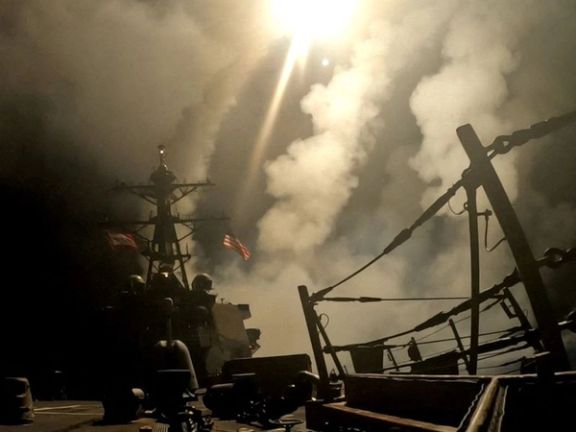
Trump warned on Monday that he would hold Iran and its leadership responsible if its Houthi allies retaliated for dozens of US air strikes on the Tehran-backed group.
The ultimatum followed a demand by the hawkish president the week before that Iran agree to a new nuclear deal or face attack.
Official media zealously swatted away apparently baseless reports circulating on social media on Monday evening that the US military had sunk Iran’s reconnaissance ship Zagros in the Red Sea.
Saberin News, a Telegram channel with nearly a million followers reportedly linked to the Revolutionary Guards, denied on Tuesday the presence of any Iranian navy ships in the Red Sea, Bab al-Mandab Strait and the Indian Ocean.
Iran's national currency plummeted to an unprecedented low on Trump's ominous remarks, with the rial falling past the 1,000,000-per-dollar threshold in the open market.
“The reason for the spike in foreign exchange rates is the US attack on Houthis and the expectation that Iran will be the next target,” Morteza, a businessman in Tehran, told Iran International on Tuesday.
“Interestingly, people are not afraid of war although they think it is inevitable this time. They believe it will only be the government who will bear the brunt of an attack, should it materialize, and that they will come to no harm themselves,” he added.
According to Iranian-Canadian political analyst Shahir Shahidsaless, Trump may be laying the groundwork for military action against Iran if negotiations fail, either due to Iran’s refusal to engage, a lack of flexibility in talks, or if IAEA chief Rafael Grossi’s June report confirms that Tehran is rapidly advancing its nuclear program.
In a post on X on Tuesday, Shahidsaless suggested that the US operation against the Houthis could be a prelude to an attack on the Islamic Republic.
Meanwhile, Nour News, a media outlet close to Iran's Supreme National Security Council suggested on Tuesday that Tehran could withdraw from the Nuclear Non-Proliferation Treaty (NPT) if Trump acts on what it called his "delusion" that Iran seeks nuclear weapons.
A pro-government Iranian Middle East analyst and university lecturer, Mostafa Najafi, claimed in a post on X Monday that the United States has sent a backchannel message to Iran demanding the removal of its military and intelligence ships from the Red Sea and set a deadline.
According to Najafi, Iran has also warned “through its UN mission and at the military level against any American adventurism against its positions, interests, and assets.”
At the UN Security Council Monday evening, Iran's ambassador Amir-Saeid Iravani called Trump’s statements reckless and provocative and warned that any act of aggression against Iran could have severe consequences for international peace and security.
"Iran strongly and categorically rejects any accusation on the violation of relevant Security Council resolutions on arms embargoes in Yemen or involvement in any destabilizing activities in the region," Iravani said on Monday.
Iran and the Houthis have denied close military coordination, but weapons experts have linked the Yemeni fighters' advanced arsenal of anti-ship and ballistic missiles to Iranian technology. Iran has long presented the Houthis as an important part of its so-called "Axis of Resistance" against Israel and the United States.

One of Iran’s most hardline media commentators warns that negotiating with the United States will increase the likelihood of an attack on Iran, arguing that accepting Washington’s terms would leave the country more vulnerable.
US-educated hardliner Foad Izadi, often cited by Iranian media as an expert on US politics, told the conservative Nameh News website that Washington has refrained from attacking Iran because it views such a move as too costly.
"Those who do not want their country to be attacked by the United States should not repeat Trump's statements," Izadi said. He also claimed that Washington is pressuring Iran’s neighbors to cut economic ties, including efforts to push Iraq to halt electricity and natural gas imports from Iran.
Izadi made the remarks before President Donald Trump issued a warning to Tehran on March 17, warning that it will bear responsibility for any attack by Yemeni Houthis, who are supported by the Islamic Republic.
Hardliners within Iran's ruling circles staunchly defend Supreme Leader Ali Khamenei's refusal to negotiate with the United States, despite clear warnings by the Trump administration.
Izadi argued that "the United States wants to limit Iran's access to conventional weapons. Therefore, negotiating with Washington is likely to increase the possibility of a US attack on a weak Iran."
Meanwhile, a prominent politician close to former President Hassan Rouhani, who supports
A prominent politician close to former President Hassan Rouhani, who supports negotiations, offers a different perspective, stating, "The United States is genuinely seeking a solution to its dispute with Iran over Tehran's nuclear program."
In an interview with the moderate conservative website Khabar Online, Mahmoud Vaezi, a senior aide to Rouhani and deputy leader of the Moderation and Development Party, said Washington is genuinely pursuing détente with Iran and hopes to resolve the ongoing nuclear dispute.
"Lifting US sanctions through negotiations with Washington will bring about an economic breakthrough in Iran," Vaezi asserted. Referring to plans for the Iranian New Year, which begins on March 20, he stressed that Iran must make difficult decisions to address its deepening economic crisis, which has severely impacted people's livelihoods.
He further emphasized the need for swift action to ease tensions with the United States and other countries, calling it a necessary step in the broader reforms required to stabilize living conditions in Iran.
The politician also urged Iranian officials to work toward removing barriers to international trade, reducing government intervention in economic affairs, and strengthening the private sector. He emphasized the need to foster a fair competitive environment to encourage greater private sector participation in the economy.
Like many other politicians in the Reformist camp, including Rouhani, Vaezi emphasized that Khamenei has not completely ruled out negotiations with the United States. He also tried to highlight contradictions in Trump's statements and actions.
In another development, Iranian academic and international law expert Mehdi Zakerian suggested in an interview with the reformist Shargh daily that Foreign Minister Abbas Araghchi should take a more proactive role in breaking Iran’s diplomatic deadlock. He argued that the current foreign policy crisis does not justify inaction. "The art of a diplomat is to offer solutions to crises. Stepping into an ideal situation and signing a pre-written agreement would be easy for anyone."
Expressing regret, Zakerian said, "Iran has missed many opportunities to actively resolve its own disputes with other countries and to contribute to regional conflict resolution." As examples, he pointed out, "Iran could have made more constructive decisions during last year’s wars in Gaza and Lebanon."

Tehran has denied that its foreign minister’s visit to Oman on Sunday was related to the US President’s letter to Iran's Supreme Leader. However, observers speculate that Tehran is seeking Muscat’s mediation.
President Donald Trump’s recent letter to Supreme Leader Ali Khamenei was delivered by former UAE Minister of State Anwar Gargash last week. Tehran, however, has not responded to the letter yet and seems unlikely to use the same diplomatic channel.
At a press briefing on Monday morning, Foreign Ministry Spokesman Esmaeil Baghaei dismissed a connection between Araghchi’s visit to Muscat and Trump’s letter and said the response to the letter “will be made through the appropriate channels after scrutiny is completed.” According to Baghaei, the contents of Trump’s letter will not be disclosed to the media.
Oman’s role in US-Iran diplomacy
In an interview with the government-run Iran newspaper after Khamenei’s public rejection of direct talks with Washington last week, Foreign Minister Abbas Araghchi signaled Tehran's willingness to engage in indirect negotiations through Oman.
For over two decades, Iran has relied on Oman as an intermediary for indirect communications with Washington, despite the existence of a formal diplomatic channel through Switzerland.
However, some observers link Araghchi's visit to Oman to US air strikes on Iran-aligned Houthis in Yemen. Referring to the US airstrikes on Saturday, conservative political analyst Asghar Zarei in Iran told Quds daily that the threat of further escalation has necessitated “consultations and the exchange of messages through Oman.”
But at the same time, citing Abu Dhabi’s close political and military cooperation with Israel and the West, Zarei further argued that Iran would not entrust the delivery of its response to Trump's letter to the UAE.
“Oman … has always shown its willingness to play an active role in regional issues, including the Syrian issue, and mediation between Iran and other powers,” the same daily quoted West Asia analyst Reza Sadrolhosseini as saying.
Some analysts also consider Baghdad and Doha as potential but much less likely alternatives for diplomatic exchanges between Tehran and Washington.
Iran's response to Trump
Trump sent another letter to Khamenei in 2019, after unilaterally withdrawing from the 2015 nuclear deal but Khamenei refused to accept the letter, delivered by then-Japanese Prime Minister Shinzo Abe, and insisted that Trump was untrustworthy.
The Iranian foreign minister’s meeting with his Omani counterpart, according to both sides, focused on bilateral relations and the latest regional and international developments. In a statement, Oman’s foreign ministry also emphasized the country's commitment to facilitating diplomatic solutions and easing regional tensions through dialogue and peaceful means.
Former President Barack Obama reportedly sent multiple letters to Khamenei between 2009 and 2015, discussing topics such as diplomacy, the nuclear deal (JCPOA), and potential cooperation against ISIS. There are no reports that Khamenei ever responded in writing to any of these letters. This time, however, as indicated by the foreign ministry's spokesman, a written response, possibly through Muscat, seems to be very likely.
Araghchi’s visit and the Yemeni situation
Some Iranian media and analysts have highlighted a possible connection between Trump’s most recent threats against Iran, the US airstrikes on Yemen, and Araghchi’s visit to Oman.
A commentary published on Monday by the reformist Ham-Mihan daily referred to Trump’s warning that supporting Houthis will not be tolerated and argued that by these airstrikes he aimed to demonstrate to Iran that there are only two options on the table: negotiation or military action, as in Yemen's case. Iran denies control over Houthis and has condemned the US strikes.
“The only thing that Iran does not need now is a new crisis,” the commentary said while suggesting that Iran should stay fully focused on the resolution of its nuclear program.

A significant rift has emerged within Iran's ultra-hardliner faction following a prominent lawmaker’s unprecedented criticism of protests by radicals to pressure authorities into enforcing a tough hijab law.
The decision of the Supreme National Security Council (SNSC) not to enforce the controversial law could not have been made without the approval of Supreme Leader Ali Khamenei, who has avoided discussing the issue in his speeches for months.
Enforcing the morality legislation—which imposes severe penalties, including heavy fines and prison sentences on women who violate strict hijab rules, as well as businesses that fail to comply—could be highly provocative under current conditions, potentially sparking widespread anti-government protests.
Internal clash over the enforcement of the hijab law
Mahmoud Nabavian, a senior member of the hardline Paydari (Steadfastness) Party and the Parliament’s National Security and Foreign Policy Committee, is facing backlash from his allies after condemning recent protests led by radical elements. His remarks have surprised many within his faction, where he was long regarded as a key figure and a strict enforcer of their agenda.
Despite playing a key role in drafting the hijab legislation, Nabavian now argues that preserving the Islamic Republic must take precedence over enforcing the law—implicitly acknowledging the risk of unrest. “If implementing the hijab law creates tensions and weakens the system, it should automatically be set aside,” he said last week.
According to the Islamic Republic’s founder, Ruhollah Khomeini, preserving the system must take “utmost priority,” even if it requires temporarily setting aside religious obligations like prayer and fasting. By that logic, hijab would be no exception—a stance authorities now seem compelled to accept, much to the frustration of the hardline political and religious establishment.

Concerns over national stability
Nabavian justified the security council’s suspension of the hijab law by pointing to major geopolitical developments—the fall of Bashar al-Assad in Syria and Israel’s assassination of Hezbollah chief Hassan Nasrallah. He argued that enforcing the law at this time could provide foreign adversaries with an opportunity to destabilize Iran.
“Given the country’s and the region’s current conditions, especially the situation in Yemen, and the need for national unity, we must all support the implementation of the law but polarizing the society, calling for illegal gatherings, and staging street protests—no matter the faction—are against the country’s interests,” Nabavian warned in an X post on Sunday. His remarks came after the US military launched massive airstrikes against Iran-aligned Houthi rebels in Yemen on Saturday.
Hasan Soleimani, editor-in-chief of the hardline Mashregh News, a publication believed to be linked to the Revolutionary Guards Intelligence Organization (SAS), defended Nabavian’s position. In an X post, he accused radical hardliners of using the hijab issue as a pretext to disrupt the country’s stability. He went further, comparing them to the Forqan group—an Islamist faction that carried out assassinations against officials of the newly established Islamic Republic, including a failed attempt on Khamenei’s life in 1981.
Highlighting defiance of Khamenei’s decisions
Nabavian also accused ultra-hardliners—whom he refers to as “super-revolutionaries” or “radicals”—of openly defying Khamenei, citing their opposition to Covid vaccination. “I won’t even mention the disgraceful remarks they made [about Khamenei’s own vaccination],” he said last week. He also linked their defiance to more recent criticism over Iran’s two-month delay in 2024 before retaliating against Israel’s attack on Iranian military facilities—a decision ultimately made by Khamenei.
Similarly, if Khamenei decides to permit direct talks with the Trump administration in the coming weeks or months, ultra-hardliners’ reaction could pose a significant challenge. He ruled out the possibility of such talks in a recent speech and has so far not acknowledged the US President’s letter to him. Former President Hassan Rouhani suggested a few days ago that Khamenei’s stance could change depending on circumstances, as it did in 2013 when he allowed secret talks with the US.
Warnings of a fragile political climate
Citing the hardliners' protests in Mashhad against moderate conservative Hassan Rouhani’s government on December 28, 2017, some media outlets and analysts have warned that demonstrations organized by “super-revolutionaries” could similarly spiral out of control.
The Mashhad protests quickly spread nationwide, with demonstrators in several cities chanting against Khamenei. The weeklong unrest resulted in at least 25 deaths and thousands of arrests.
However, the current situation is fundamentally different from 2017, an article in the reformist Etemad daily warned on Sunday. It pointed to Trump's presence in the White House and heightened regional tensions, citing a statement from the Supreme National Security Council Secretariat that cautioned any provocation or political polarization could cause irreparable damage to the country.

Tehran will respond privately to US President Donald Trump's letter and will not make public its contents, according to Iran's foreign ministry.
"We currently do not intend to release the contents of Trump's message to the media," said Spokesperson Esmail Baghaei during a press conference on Monday.
Last week, an Emirati official brought a letter from the US president proposing nuclear talks with Tehran, which Supreme Leader Ali Khamenei rejected, saying such a proposal was deception from Washington amid crippling sanctions on Iran.
"Our response to this correspondence will be provided through appropriate channels after the completion of the reviews. What has been published in the media is mostly speculation and lacks a precise basis."
Baghaei noted that the letter's content "is not significantly different from Trump's speeches and is structured based on those elements."
The spokesman described US messages as contradictory signals, noting that while expressing readiness for talks, the US continues to impose sanctions.
He specifically criticized the US for sanctioning Iran's oil minister, whose "only crime is performing his official, legal, and national duties."
"Diplomatic negotiations have etiquette in that each side must recognize the other's interests and, more importantly, believe in fulfilling their commitments," he added during the televised press conference.
"The US does not respect that and uses the possibility of negotiations as a propaganda and political tool."
During his first term, President Trump withdrew the US from the 2015 Joint Comprehensive Plan of Action (JCPOA), an agreement between Iran and major powers that limited Iran's nuclear activities in exchange for sanctions relief. Following the 2018 US withdrawal and reimposition of sanctions, Iran exceeded the JCPOA's nuclear activity limits.
Western powers express concern that Iran's uranium enrichment, reaching up to 60% purity, indicates a potential pursuit of nuclear weapons, an allegation Iran denies, asserting its program is for peaceful purposes and compliant with international law.
Baghaei also highlighted recent diplomatic activities, including a trip by Foreign Minister Abbas Araghchi to Oman on Sunday, a trilateral meeting in Beijing with Russia and China, and a visit by the Deputy for Legal and International Affairs to Vienna for talks with the International Atomic Energy Agency (IAEA).
He stressed that Araghchi's Oman trip was unrelated to Trump's letter and had been scheduled beforehand.
In response to questions about US military strikes against the Iran-backed Houthis in Yemen, Baghaei condemned the attacks as a crime and a violation of international law.
"The US has unfortunately mistaken the victim for the criminal," he said, calling on the international community to take urgent action.
He also rejected US claims that Iran was behind the Houthi's blockade of commercial shipping in the Red Sea, saying the Yemeni people make their own decisions.
The denials came on the back of claims made on Sunday by Revolutionary Guard Corps (IRGC) Commander Hossein Salami who categorically denied US accusations of Iranian control over the Houthis', in spite of the blockade being ordered by Iran's Supreme Leader in allegiance with Iran-backed Hamas amid the Gaza war, back in 2023.
"We have always declared, and we declare today, that the Yemenis are an independent and free nation in their own land and have an independent national policy," Salami said.
"Ansarullah, as the representative of the Yemenis, makes its own strategic decisions, and the Islamic Republic of Iran has no role in setting the national or operational policies of any movement in the resistance front, including Ansarullah in Yemen."

During his June 2024 election campaign and his first six months in office, Iran's President Masoud Pezeshkian positioned himself as the "good cop" in the country's familiar good cop/bad cop dynamic between reformists and hardliners.
He embraced this role both domestically—advocating for civil rights, gender equality, and press freedom—and in foreign policy, where he emphasized maintaining good relations with all countries and resolving Iran’s nuclear dispute with the West as a path to economic recovery.
However, on February 7, Pezeshkian abruptly shifted from a pragmatic politician to a staunch hardliner with strong ideological overtones following a routine anti-US and anti-negotiation speech by Supreme Leader Ali Khamenei. Just weeks later, in an uncharacteristically heated tone, he went so far as to declare that he had no desire to engage with US President Donald Trump.
Whether Pezeshkian's "good cop" role was genuine or not, it may have served Khamenei’s interests at a time when he faced pressure to engage with the Trump administration. However, as Pezeshkian loses credibility among Reformists, hardliners remain hesitant to fully embrace him. His occasional expressions of regret—admitting shame over unfulfilled promises in domestic politics—have only deepened his political isolation.
The Supreme Leader has found a new "good cop" in Foreign Minister Abbas Araghchi, who was permitted to propose indirect negotiations with the United States in Muscat—despite Khamenei’s firm rejection of talks with Trump.
Recently, an Iranian commentator abroad half-jokingly categorized Iranian politicians into three groups based on their stance on nuclear negotiations with the United States. The first group consists of hardliners, led by ultraconservative Saeed Jalili, who oppose talks. The second includes moderates from centrist parties, such as former President Hassan Rouhani, who advocate for negotiations. The third group, he said, is led by President Pezeshkian—who, regardless of his stance, has no real influence over the nuclear issue.
Pezeshkian appears to lack clear solutions on other pressing issues as well. Addressing Iran’s soaring prices, he recently admitted, "I have no idea whom to blame for the uncontrolled rising prices." His remark drew sharp criticism on social media, where many reminded him that, as president, he is ultimately responsible for the government's handling of the crisis.
The Khabar Online website reported Friday that Pezeshkian has failed to deliver on four key promises, along with nearly all his other commitments. The report highlighted public dissatisfaction over continued social media censorship and his unresolved negotiations with hardliners on the strict compulsory hijab law. While enforcement has been temporarily suspended, the government has neither scrapped the bill nor convinced hardliners to stop harassing women and politicians.
The website also pointed to two major economic issues affecting Iranians' livelihoods that Pezeshkian has failed to address. He has been unable to persuade the Expediency Council to approve the FATF protocols, which could ease barriers to international trade and banking. More importantly, his promise to lift sanctions—seen as key to reviving the economy—remains unfulfilled. Now, he is not even willing to discuss the issue with the US, declaring, "Do whatever the hell you can do. I am not going to talk with you."
His critics—including ultraconservative Paydari Party members determined to unseat him, the so-called neocons aligned with Parliament Speaker Mohammad Bagher Ghalibaf, and hardline zealots who attack him at every turn for not enforcing strict Islamic hijab rules—are relentless in their pressure.
Pezeshkian’s vice president for legal affairs, Majid Ansari, blamed Paydari for the challenges the president is facing. "They have not shut down their campaigns and are still working to tarnish Pezeshkian's image," he told the media last week.
Pezeshkian is no longer the "good cop," yet no one sees him as the "bad cop" either. As one commentator put it on a Persian TV, perhaps he is no cop at all. Still, some Iranians believe in his good intentions. Despite his limited social backing, like the protagonist in the 1950s classic cartoon Deputy Dawg, he may have "a badge of tin," but he certainly has "a heart of gold."