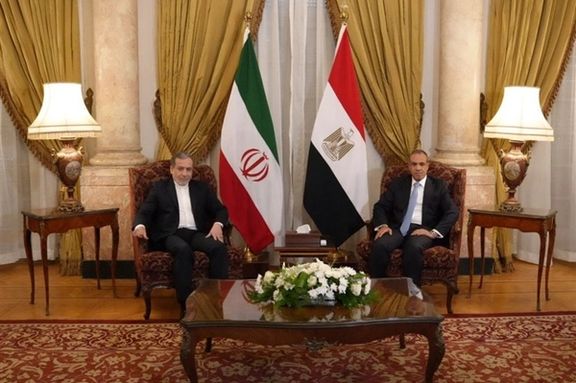
Iran's Foreign Minister Abbas Araghchi and Egyptian Foreign Minister Badr Abdelatty in Cairo, June 2, 2025
The Iranian Foreign Minister’s recent visit to Cairo could signal progress toward healing one of the explosive region's deepest rifts, which has lingered from the Iranian Revolution and Egypt's peace treaty with Israel.
The relationship between the Sunni Muslim heavyweight and the Shi'ite theocracy has been in a deep freeze ever since.
Following Araghchi’s June 2 meeting with Abdel Fattah al-Sisi, the top Iranian envoy himself wrote in an Arabic post on X that diplomacy between Iran and Egypt had entered a new phase.
“The level of interaction and political cooperation, and most importantly, the level of trust and confidence in the relations between the two countries, is unprecedented.”
In a diplomatically worded but significant statement, the Egyptian presidency said sides had emphasized “the importance of pursuing the current path to explore prospects for further advancing the two countries’ relations.”
Egyptian media similarly adopted an optimistic tone, with Egypt Today describing Araghchi’s visit as “one of the most visible signs of rapprochement” and noting it could signal “potential shifts in regional alliances and cooperation.”
What might resumed relations mean?
Egypt is a close US ally and maintains official relations with Israel. For Iran, mending the 45-year rift with Egypt could signal a softening of its revolutionary-era, anti-American posture.
Ayatollah Ruhollah Khomeini famously called for the Egyptian people to rise up and overthrow Anwar Sadat after he normalized ties with Israel.
It would also send a strong message across the region that longstanding hostilities and rivalries can give way to cooperation.
Cairo, whose influence in the Arab world is much diminished following the quashing of Arab Spring protests and ongoing economic challenges—could bolster its image as a leading Arab power by positioning itself as an interlocutor between Iran and both Western and Arab nations.
Arab states in the Persian Gulf have taken Egypt's mantle of regional leadership following the unrest starting in 2011, but while all have a testy relationship with Tehran but only Cairo has not revived diplomatic ties or reopened its embassy in Iran.
The timing of Araghchi’s visit with that of International Atomic Energy Agency (IAEA) Director General Rafael Grossi—leading to a trilateral meeting—may be an indication of Egypt’s intent to play a mediating role in the Iranian nuclear file.
How did relations break down?
Tehran and Cairo have not had full diplomatic relations since 1979, when Iran’s Islamic Revolution ousted the Shah.
Egypt’s decision to host Iran's exiled monarch—who died and was buried in Cairo in 1980—sparked Iranian anger.
That same year, Iran officially cut ties with Egypt after it became the first Arab country to recognize Israel by signing the Camp David Accords.
Relations deteriorated further when Egyptian President Anwar Sadat was assassinated in 1981 by Islamist army officer Khaled Al-Islambouli.
In a controversial move, Iran named a street in Tehran after Islambouli—an act Egypt has long viewed as a profound insult.
Despite the hostility, the two countries agreed in the early 1990s to restore diplomatic relations at the level of chargé d'affaires—a status that has remained in place for more than three decades.
What are the obstacles to full resumption of diplomatic relations?
Iran’s strong opposition to the Camp David treaty and its revolutionary posture in the post-1979 era set the foundation for decades-long rift with Egypt.
While successive governments have considered changing the street’s name as a goodwill gesture, hardliners have repeatedly blocked such efforts.
Though there have been several high-level encounters between Iranian and Egyptian officials since 2012, most have occurred on the sidelines of international or regional summits.
In August 2012, Egyptian President Mohamed Morsi made a landmark visit to Tehran to hand over the rotating presidency of the Non-Aligned Movement (NAM) summit to Iran.
It was the first visit by an Egyptian head of state to Iran since 1979 and marked a sharp departure from the policies of Morsi’s predecessor, Hosni Mubarak.
That visit was followed by Iranian President Mahmoud Ahmadinejad’s trip to Cairo in February 2013 to attend the Organization of Islamic Cooperation (OIC) summit—another rare show of diplomacy between the two sides.
Fast forward to 2023, Iranian President Ebrahim Raisi ordered steps to improve ties with Cairo. Later that year, in November, he met al-Sisi during the Joint Arab-Islamic Summit in Riyadh.
In December 2024, Raisi’s successor, President Masoud Pezeshkian, visited Cairo at al-Sisi's invitation to attend the D-8 Organization for Economic Cooperation summit. During the visit, Pezeshkian held meetings with al-Sisi and other top Egyptian officials.
Accompanying him was Araghchi, who has since made three subsequent visits to Cairo.
Iran’s Foreign Minister Abbas Araghchi arrived in Beirut on Tuesday for meetings with Lebanon’s top officials, while calling for a new chapter in bilateral ties and expressing support for Lebanon’s territorial integrity.
“I hope that, in light of the new regional conditions and Lebanon’s new circumstances, a new chapter of respectful relations between Iran and Lebanon will begin,” Araghchi said at Rafic Hariri Airport.
Araghchi also met with his Lebanese counterpart, Youssef Rajji, and is also scheduled to meet the country’s president, parliament speaker and prime minister during his visit.
Lebanon elected Joseph Aoun as its new president in January 2025 — a figure backed by the United States who is now working to strengthen the army and counterbalance Hezbollah's influence after the Iran-backed militant group was severely weakened by Israel last year in a spate of high-stakes military operations.
Lebanon’s new prime minister, Nawaf Salam, said in late May that "the era of exporting the Iranian revolution is over," adding, "We will not remain silent in the face of weapons outside the control of the state."
The Wall Street Journal reported last week that Lebanon’s army has largely disarmed Hezbollah in its southern strongholds — in part with the help of Israeli intelligence.
The country’s new government continues enforcing a fragile ceasefire between Hezbollah and Israel, which began last year but has seen both sides alleging scores of breaches from the other.
Araghchi made no mention of these developments in his remarks and instead said that Iran would continue to support Lebanon against Israel, while stressing that this support does not amount to interference in Lebanon’s internal affairs.
“Lebanon’s independence, sovereignty, and territorial integrity are of great importance to us and to the entire region,” he said. “We have supported Lebanon’s sovereignty at all stages, and we will continue to do so against the Zionist regime’s occupation — this is simply the support of a friend for its friends and not an act of interference.”
“No country in the region has the right to interfere in the internal affairs of other regional countries,” he added.
Signs of unease are surfacing in Tehran as the two-month clock reportedly set by Washington to reach a nuclear deal runs down and European powers move to revive UN sanctions suspended under the 2015 agreement.
Iranian and US officials held their first round of indirect talks in Oman on April 12. That leaves just two weeks before President Donald Trump’s reported deadline expires.
Without a deal, the E3—France, Germany, and the United Kingdom—are expected to trigger the dispute resolution mechanism at the next board meeting of the UN nuclear watchdog in June. That would lead to the automatic return of UN sanctions on Iran by October.
“Delay in decision-making amounts to surrendering to a scenario of war and economic collapse,” wrote attorney Massad Saliti in Iran Diplomacy, an outlet close to the Foreign Ministry.
“If the Iranian government fails to find a diplomatic solution within this short window, pressure from the United States, Europe, and Israel could threaten the country's stability to an unprecedented degree,” he added.
Saliti outlined three challenges Iran could face beyond Washington’s maximum pressure campaign if talks fail: first, the E3 may “snap back” all UN sanctions; second, Israel may strike unilaterally; and third, domestic unrest could flare up, fueled by deepening economic isolation.
None of these scenarios appear imminent. Officials in Tehran and Washington have so far maintained cautious optimism that negotiations will bear fruit. But as Trump said Wednesday, everything could change with “one phone call.”
He put it more bluntly on Friday: “Iran does not want to be blown up. They would rather make a deal. And I think that could happen in the not-too-distant future.”
Europeans’ Role
Disagreements with Europe may also complicate Iran’s separate negotiations with the US, wrote foreign policy commentator Jalal Khoshchehreh in Khabar Online.
“Iran, the United States, and Europe remain firmly entrenched behind their respective red lines, making meaningful concessions difficult,” he argued, calling the situation “alarming for all parties involved.”
Still, one hopeful sign remains, Khoshchehreh wrote---that Washington and Tehran are actively looking for ways to keep talks alive. For once, he said, US officials sound more pragmatic than their E3 counterparts.
The E3’s hard line, he argued, may be both a reaction to and a reflection of their diminished influence. But their stance would matter little if Washington and Tehran reach a deal.
“It is Tehran and Washington that must sign any potential agreement. Therefore, despite the E3’s nay-saying in tandem with Tel Aviv, if the two main parties find a ‘balance point’ between their red lines, others will have no choice but to follow,” Khoshchehreh wrote.
Saliti went further.
“Iranian officials," he wrote, "should make the most of the remaining time to … urgently and transparently reach a comprehensive and lasting agreement—one that addresses all aspects of Iran’s nuclear program, missile activities, and regional engagements.”
Hossein Shariatmadari, the representative of Iran's Supreme Leader in the hardline daily Kayhan, has called on authorities to question French nationals visiting Iran about their stance on Israel, and to detain those who refuse to condemn it.
The suggestion follows the continued detention of Mahdieh Esfandiari, a 39-year-old Iranian translator living in Lyon who has been detained since early March for supporting Hamas' October 7 attack on Israel in Telegram posts.
Shariatmadari framed the arrest as politically motivated and urged a reciprocal response.
"If religious principles do not permit imprisoning them, at the very least, arrest them and then expel them from the country," he said.
In addition to Esfandiari, France has arrested a dual Iranian-French national, Shahin Hazamy, on charge of “apologie du terrorisme,” a criminal charge under French law covering praise of terrorist acts.
The Iranian Judiciary's official news agency Mizan described him as an independent journalist and said the arrest stemmed from his support for Palestine, without citing French legal charges.
Posts on Hazamy’s Instagram account show support for Hezbollah and Palestinian factions backed by Tehran, as well as images taken during recent visits to Lebanon.
Iran’s foreign ministry has criticized both arrests, demanding explanations and consular access. Spokesman Esmail Baghaei said in April that the detentions raised serious concerns over the rights of Iranian nationals in France.
France, meanwhile, says Iran detains French citizens as leverage in diplomatic disputes. Foreign Minister Jean-Noël Barrot urged French nationals not to travel to Iran, citing the risk of arbitrary arrest.
In January the European Parliament adopted a motion for a resolution condemning Iran’s detention of European Union citizens, labelling the practice as “hostage diplomacy" accusing Iran of using the prisoners for political ends.
The softened tone of Tehran’s statements on nuclear negotiations with the United States, along with unprecedented remarks from media commentators, suggests Iran may be open to a "suspension for suspension" agreement with Washington.
The softened tone of Tehran’s statements on nuclear negotiations with the United States, along with unprecedented remarks from media commentators, suggests Iran may be open to a "suspension for suspension" agreement with Washington.
Except for state television, the hardline daily Kayhan, and a few low-profile newspapers, most Iranian media outlets this week have discussed “positive signals from Washington” or even “an imminent final deal.”
Outlets frequently cite what is seen in Tehran as optimism in US coverage.
President Donald Trump told reporters on Wednesday that he advised Israeli prime minister Benjamin Netanyahu not to launch a strike on Iran, saying a deal with Tehran was “very close.”
Tehran-based Rouydad24 noted that even traditionally skeptical figures—such as International Atomic Energy Agency (IAEA) Chief Rafael Grossi and Russian Foreign Minister Sergey Lavrov—have acknowledged the possibility of a US-Iran agreement within weeks.
Early signs of a shift
The clearest signal yet of Iran’s openness came on Wednesday, when prominent lawmaker and National Security Committee member Abolfazl Zohrehvand told the conservative Nameh News that Tehran could suspend uranium enrichment in exchange for partial sanctions relief.
“Omani officials are telling us: Let’s try this,” Zohrevand said, recalling Iran’s acceptance of a similar deal under Supreme Leader Ali Khamenei in the early 2000s.
President Masoud Pezeshkian also praised Oman’s mediation role during his visit to Muscat on Tuesday, calling the country the only active intermediary that Iran trusts—another nod to potential flexibility.
This comes along with hints that Tehran “may reconsider its longstanding ban on US nuclear inspectors,” as part of an agreement with Washington, according to Iran’s nuclear chief Mohammad Eslami.
Interim deal to avoid war
The pro-reform daily Arman Melli highlighted the apparent shift in tone, suggesting that a “halt for halt” arrangement might be in the works—one often called an “interim agreement” by officials, perhaps to make it more palatable for hardliners.
But nothing is done until it is done, the paper warned.
“Making a deal is as likely as is a sudden change that might stop all negotiations without much explanation,” it wrote, asserting that technical-level discussions are ongoing alongside secret bilateral talks.
Prominent reformist figure Mohammad Sadeq Javadi Hesar told Etemad newspaper that the government’s flexibility aligns with Iran’s national interests.
Likewise, reformist commentator Hamid Reza Jalaipour told Khabar Online that Iran cannot strengthen ties with Russia and China without first mending its fraught relationship with the US.
He predicted that a deal could marginalize the hardline minority who push anti-American rhetoric, call for Israel’s destruction, and stricter control at home..
Tehran, he noted, appears to have shifted its motto from “no negotiations, no war” to “negotiations to avoid war.”
More than a decade after Canada cut diplomatic ties with Iran, tensions remain high as calls to reopen embassies are met with deep resistance from Iranian Canadians who fear the Islamic Republic's influence and repression on Canadian soil.
Ali has been living in Canada for eleven years. When he and his wife immigrated, the Islamic Republic's embassy in Ottawa had already been closed, with diplomatic ties severed two years earlier.
Although Ali has never returned to Iran since arriving in Canada, his wife has made necessary trips back and had to renew her Iranian passport through the Interests Section of the Islamic Republic in Washington, DC.
One of these renewals contained legal errors — leaving her stranded in Iran at the time of the downing of Ukraine International Airlines Flight PS752.
On January 8, 2020, amid heightened tensions between Iran and the US following the killing of Qassem Soleimani, Flight PS752 was shot down by two missiles fired by Iran’s Islamic Revolutionary Guard Corps (IRGC) just six minutes after takeoff from Tehran.
All 176 people on board — as well as an unborn child — were killed.
Of those passengers, 138 were ultimately headed to Canada. The loss of 55 Canadian citizens and 30 permanent residents turned the downing into a national tragedy and further deepened the diplomatic rift between Ottawa and Tehran.
Canada cut diplomatic ties with Iran and shut down its embassy in Tehran in 2012, citing several concerns: Iran’s support for the Assad regime during the Syrian civil war, its defiance of United Nations resolutions on its nuclear program, ongoing threats against Israel, and security risks to Canadian diplomats after the British embassy in Tehran was attacked in breach of the Vienna Convention.
Iranians take to the streets of Toronto to support Woman Life Freedom movement in 2023
Iran’s message to Canada’s new government
In a rare development, CBC's senior international correspondent Margaret Evans was granted access to Iran earlier this month. During a press conference, she asked Esmail Baghaei, spokesperson for Iran’s Ministry of Foreign Affairs, about the future of diplomatic relations with Canada.
Baghaei responded: "The relationship was frozen unilaterally by Canada, not by Iran, and we never welcomed that decision because we think that decision was not for the benefit of either of the two nations."
He added: "I think it's for Canada to decide what course of action they want to take. I think the first step they have to take is to unravel the many sanctions and restraints that they have imposed on themselves and on our bilateral relations. We were never in favor of severing ties. Hundreds of thousands of Iranians live in Canada, and they were the first to suffer from this situation."
But for many in the Iranian-Canadian community, the presence of an Iranian embassy in Canada is not seen as benign — nor missed.
A matter of security and influence
Many Iranian Canadians argue that Iranian embassies abroad function less as diplomatic institutions and more as extensions of the regime’s intelligence and influence operations.
Critics say these missions monitor dissidents and facilitate connections with proxy groups abroad.
Ali, for one, opposes any effort to reopen the Islamic Republic’s embassy in Canada. "Despite weak immigration enforcement that has allowed many former regime officials to settle here," he says.
"The continued closure of the Islamic Republic's embassy in Ottawa has at least prevented further infiltration and harmful activity."
Canada’s official position: no plans to reengage
The Canadian government has made it clear that it has no intention of reestablishing diplomatic ties under current conditions. In response to a request from Iran International, Global Affairs Canada stated:
“Iran must make fundamental changes in its behavior — both domestically and internationally — before the re-establishment of diplomatic relations with Canada can be considered.”
The statement went on to say that Canada remains deeply concerned about:
Iran’s destabilizing activities in the Middle East
Violations of international human rights commitments, especially against women, girls, and minority groups
Until meaningful change is seen, Canada will continue its pressure campaign, which includes:
Listing Iran as a state supporter of terrorism under the State Immunity Act
Listing the IRGC as a terrorist organization under the Criminal Code
Imposing targeted sanctions
Conservatives: No normalization with a terrorist state
Since the beginning of Iran’s “Woman, Life, Freedom” movement in 2022, Canadians have repeatedly expressed support for the Iranian people. In 2024, the Canadian government officially listed the IRGC as a terrorist organization — a move long advocated by Conservatives.
Garnett Genuis, the Conservative MP who first introduced a motion in 2018 to designate the IRGC as a terrorist entity, reaffirmed his party’s position in an exclusive comment to Iran International:
“Proposals to re-establish ties with this extremist, terrorist-supporting regime are completely unacceptable. While the Liberals have historically supported reopening relations, Conservatives are proud of our record of standing up to the regime and supporting the Iranian people.”
Garnett Genuis conservative Mp in exclusive interview with Iran international
“The Iranian people deserve the opportunity to choose a government that reflects their aspirations for justice and peace. We stand with the people of Iran — not the regime. That will not change.”
Diplomacy — or expanded access for the Islamic Republic?
Some argue that diplomatic relations might help resolve bilateral issues — such as the investigation into the downing of PS752. Others believe such ties only give the Islamic Republic more room to maneuver. They point to countries like Sweden and the UK, where Iranian embassies exist but have done little to increase Tehran’s accountability.
Iranian Canadians have voiced their stance clearly in recent years. Tens of thousands have participated in public rallies, demonstrating not only their distance from the clerical establishment, but also their commitment to keeping Canada informed about the real demands of the Iranian people.
Today, many like Ali say they are willing to accept the consular complications that come with the absence of an embassy — if it means limiting the Islamic Republic’s access and influence in Canada.